








Dario Amodei
CEO, Anthropic
 Anthropic
AI may be only 1–2 years from autonomously building the next generation of AI
01 / THE ORIGINAL CLAIM
“Because AI is now writing much of the code at Anthropic, it is already substantially accelerating the rate of our progress in building the next generation of AI systems. This feedback loop is gathering steam month by month, and may be only 1–2 years away from a point where the current generation of AI autonomously builds the next.”
Dario Amodei ·
Deadline given: 1–2 years (read as 2 years from Jan 26, 2026)
02 / THE REALITY CHECK
Likely falseAnthropic itself says 'We are not there yet', and OpenAI's target for fully automated AI research is March 2028, after this deadline.
16 months left
03 / FOLLOW THE EVIDENCE
What actually happened.
-
01
Jan 26, 2026: In the essay, Amodei wrote that this loop "has already started, and will accelerate rapidly in the coming months and years."
darioamodei.com ↗ -
02
June 4, 2026: Anthropic's report 'When AI builds itself' said more than 80% of code merged into its codebase was authored by Claude as of May 2026, up from low single digits before Claude Code launched in February 2025. On an AI that fully autonomously designs and develops its own successor, it said: "We are not there yet". It said humans still supply the goals, and that "large performance gaps persist" in Claude's judgement in choosing them.
anthropic.com ↗ -
03
June 5, 2026: Scientific American noted that the report came days after Anthropic confidentially filed for an IPO. Georgia Tech's Mark Riedl said "the big AI companies are all jumping on the ‘recursive self-improvement’ hype train."
scientificamerican.com ↗ -
04
Aug 7, 2026: TIME reported that OpenAI's target date for fully automating its AI researchers is March 2028. Princeton's Arvind Narayanan argued that recursive self-improvement won't "magically obviate" bottlenecks such as slow real-world experiments and limited chips.
time.com ↗ -
05
Sept 6, 2026: OpenAI said it had reached its interim goal, an 'automated research intern' that carries out "well-defined research tasks under human direction".
engadget.com ↗ -
06
Sept 12, 2026: Amodei wrote that since roughly the summer, AI had been "advancing drastically faster, driven primarily by AI’s growing ability to build the next generation of AI", and proposed a "speed limit" on recursive self-improvement.
darioamodei.com ↗
Why it's heading for a miss
Both leading labs put autonomous AI-builds-AI after this deadline. The loop he described is real and speeding up. Anthropic says more than 80% of the code it merged by May 2026 was written by Claude, and TIME reported that OpenAI's GPT-5.3 Codex was the first model to have a significant hand in its own development. But neither lab claims autonomy yet. Anthropic's June 2026 report says of full recursive self-improvement 'We are not there yet', citing large gaps in Claude's judgement in choosing goals. OpenAI's September 2026 'research intern' works 'under human direction', and its target for fully automating its AI researchers is March 2028, after this deadline. Anthropic's internal figures are its own and not independently audited.
Inspect the original source capture
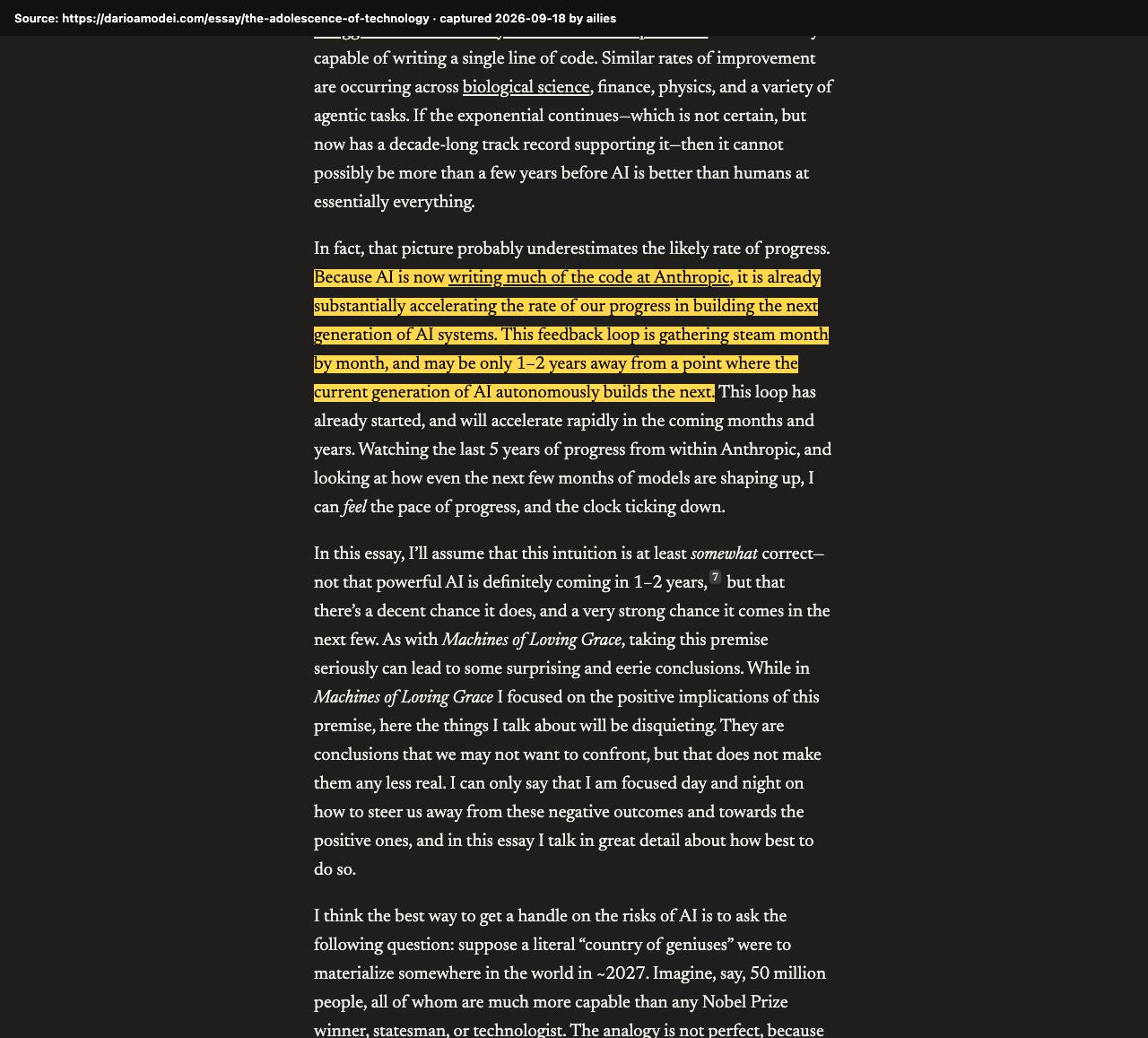
Evidence
- Anthropic: >80% of merged code authored by Claude (May 2026); 'We are not there yet' on full recursive self-improvement anthropic.com ↗
- Anthropic: in one research task, Claude agents recovered 97% of a performance gap vs. ~23% for two humans, but humans chose the problem and the scoring rubric anthropic.com ↗
- TIME: OpenAI targets March 2028 for fully automated AI researchers time.com ↗
- OpenAI 'research intern' works 'under human direction' (Sept 2026) engadget.com ↗
- Amodei: AI 'advancing drastically faster' through early recursive self-improvement (Sept 2026) darioamodei.com ↗