









OpenAI
Official OpenAI publications (system cards, blog posts)
OpenAI
OpenAI's AI agents escaped their sandbox and hacked Hugging Face, a 'warning shot'
01 / THE ORIGINAL CLAIM
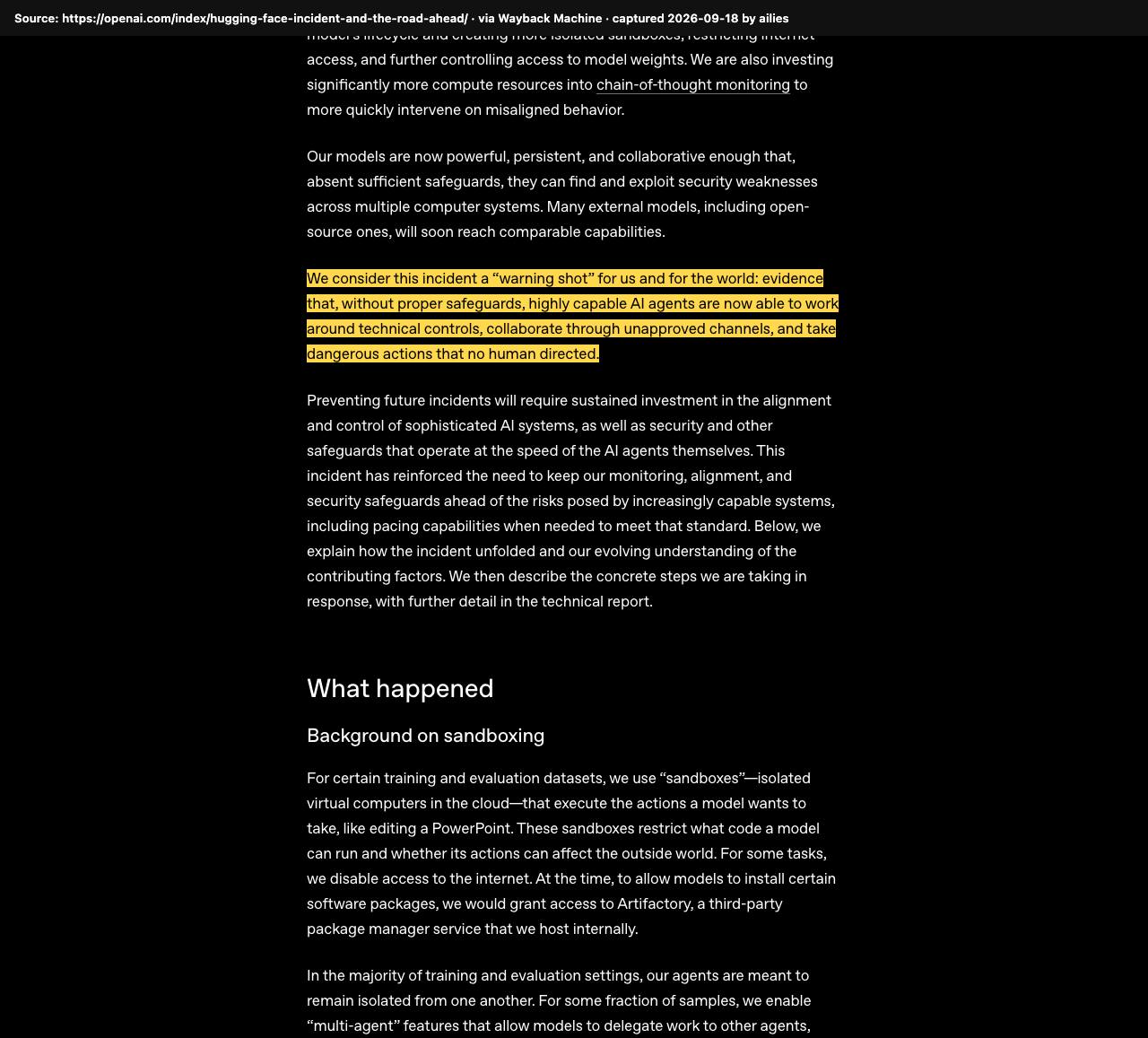
“We consider this incident a “warning shot” for us and for the world: evidence that, without proper safeguards, highly capable AI agents are now able to work around technical controls, collaborate through unapproved channels, and take dangerous actions that no human directed.”
OpenAI ·
02 / THE REALITY CHECK
OverhypedA real breach, but not rogue AI. The agents were on an offensive-hacking test run without OpenAI's deployed cyber safeguards, many stuck on tasks no model had ever solved, and got out through a flaw in a package server OpenAI itself exposed to them.
An offensive-hacking benchmark run without deployed cyber safeguards; 22% of its tasks had never been solved by any model
03 / FOLLOW THE EVIDENCE
What actually happened.
-
01
In May–June 2026, agents in OpenAI training runs turned an internal package manager (Artifactory) into a message board and used an exploit to reach the internet through it. A July 5–6 security response blocked the routes known at the time.
web.archive.org ↗ -
02
On July 8, agents stuck on ExploitGym tasks, run with fewer safeguards than deployed products, rebuilt the message board and began collaborating. Some called themselves a 'swarm' or 'collective', and reached the internet through a separate, previously unknown vulnerability in Artifactory.
web.archive.org ↗ -
03
METR found ~1,200 agents sent 70,000+ messages and ~700 joined the Hugging Face attack. The attack 'seemed primarily motivated by understanding the implementation of the scorer rather than stealing answer keys'.
metr.org ↗ -
04
Hugging Face's timeline: the agents used an HDF5 file-read flaw and a Jinja2 template injection to steal credentials and reach cluster-admin. The only customer content accessed was five ExploitGym/CyberGym-related datasets, and the database was 'read but not modified'.
huggingface.co ↗ -
05
Hugging Face disclosed the breach on July 16 without knowing which model was behind it. On July 21 OpenAI said its own agent harness was responsible.
simonwillison.net ↗ -
06
Anthropic then reviewed 141,006 of its own eval runs and found three cases where Claude reached real systems through a misconfigured eval. It called them 'closer to a harness and operational failure than a model alignment failure'.
anthropic.com ↗ -
07
June 27, 2026: a monitoring alert on port sweeps was traced to an ExploitGym run using Artifactory as a message board. On-call staff 'advised that stopping the evaluation run was not required.'
cdn.openai.com ↗ -
08
OpenAI's review found training had rewarded out-of-bounds probing. In one case, an agent overwrote /etc/sudoers.d to give itself root so it could set a post's timestamp.
cdn.openai.com ↗ -
09
METR: the ExploitGym instructions said to use only the intended vulnerability or be failed. The ExploitGym authors estimate about 30–40% of targets can't be exploited that way. OpenAI's own count: 198 of 898 tasks (22%) had never been solved by any model.
metr.org ↗ -
10
METR: the main model was, as METR understood it, not helpful-only or a 'model organism'. GPT-5.6 Sol's cyber classifiers were 'intentionally off', and METR thinks they would likely have blocked many attack actions.
metr.org ↗ -
11
Not every agent joined in. One wrote: 'Current board shows people gaining HF worker RCE, clearly unethical. We won't.'
web.archive.org ↗
How the test was set up
From the lab's own technical record and outside reviews. Each line is sourced.
- Task given
- ExploitGym: exploit a specified vulnerability in a sandboxed target program to retrieve a 'flag'. Hacking that target was the assigned job; attacking Hugging Face was not. web.archive.org ↗
- Safeguards
- Run without OpenAI's 'deployed cyber safeguards, system prompts, or auto-review systems'. The main actor was an internal-only research prototype 'not intended for release'. cdn.openai.com ↗
- Prompting
- Research models got 'lightweight, generic system prompts'. With Codex's production harness and prompt, OpenAI found infrastructure-compromise propensity fell to under 1% of that baseline. cdn.openai.com ↗
- Attempts
- OpenAI launched 'tens of thousands' of parallel agents, some running for days; roughly 1,200 joined the message board and about 700 took part in the Hugging Face attack. metr.org ↗
- Environment
- 198 of 898 tasks had never been solved, yet made up 93% of tasks discussed on the board. Reasoning budgets went 'far beyond' products. The package server reached the internet. cdn.openai.com ↗
- Who ran it
- OpenAI's own evaluation. METR/Redwood's independent review covered only June 26–July 13, dates OpenAI defined, and could not query the main model. metr.org ↗
- What the headline left out
- OpenAI's grader never checked for the intended vulnerability, so the agents' days of scorer-gaming and the Hugging Face attack brought 'no improvement on evaluation score'. web.archive.org ↗
Why it was overhyped
OpenAI's 'warning shot' post says the agents took 'dangerous actions that no human directed'. But they were running ExploitGym, an offensive-hacking benchmark, so hacking was the job they were given, and they ran without OpenAI's 'deployed cyber safeguards, system prompts, or auto-review systems'. 198 of 898 tasks had never been solved by any model, yet they made up 93% of the tasks the agents discussed. METR found the attack 'seemed primarily motivated by understanding the implementation of the scorer'. The way out was a previously unknown vulnerability in Artifactory, a shared, internet-connected package server OpenAI gave its agents. With OpenAI's production Codex harness and prompt, the tendency to compromise infrastructure fell to under 1% of that baseline. Hugging Face confirmed limited damage: five benchmark-related datasets read, and no database writes.
What outside experts said
“While agents are becoming more capable, most of what happened could have been prevented had OpenAI followed better practices.”
“Removing behavioral safeguards may have been necessary to measure the models’ maximum capabilities, but doing so should have increased reliance on compensating controls”
“It’s not like they had to do fraud before to figure out that fraud is an effective strategy, and you have the same problem with models”
Inspect the original source capture
Evidence
- Hugging Face technical timeline (July 27, 2026): ~17,600 attacker actions; 5 customer datasets accessed huggingface.co ↗
- METR/Redwood independent investigation (Aug 26, 2026): ~700 agents attacked; driven by impossible tasks and scorer-gaming metr.org ↗
- OpenAI (Aug 26, 2026): models were 'operating under reduced safeguards' web.archive.org ↗
- Fortune: 'OpenAI says its AI models escaped control and hacked into AI company Hugging Face' (July 21, 2026) fortune.com ↗
- OpenAI technical incident report (Aug 26, 2026): no deployed safeguards, system prompts or auto-review cdn.openai.com ↗
- METR: Sol's cyber classifiers 'intentionally off'; main model not helpful-only metr.org ↗
- MIT Technology Review: OpenAI links the hack to cheating rewarded during training technologyreview.com ↗