





Geoffrey Hinton
Former Google VP & Engineering Fellow (left 2023); 2024 Nobel laureate in Physics
In 2026, AI will gain the capabilities to replace many, many jobs
01 / THE ORIGINAL CLAIM
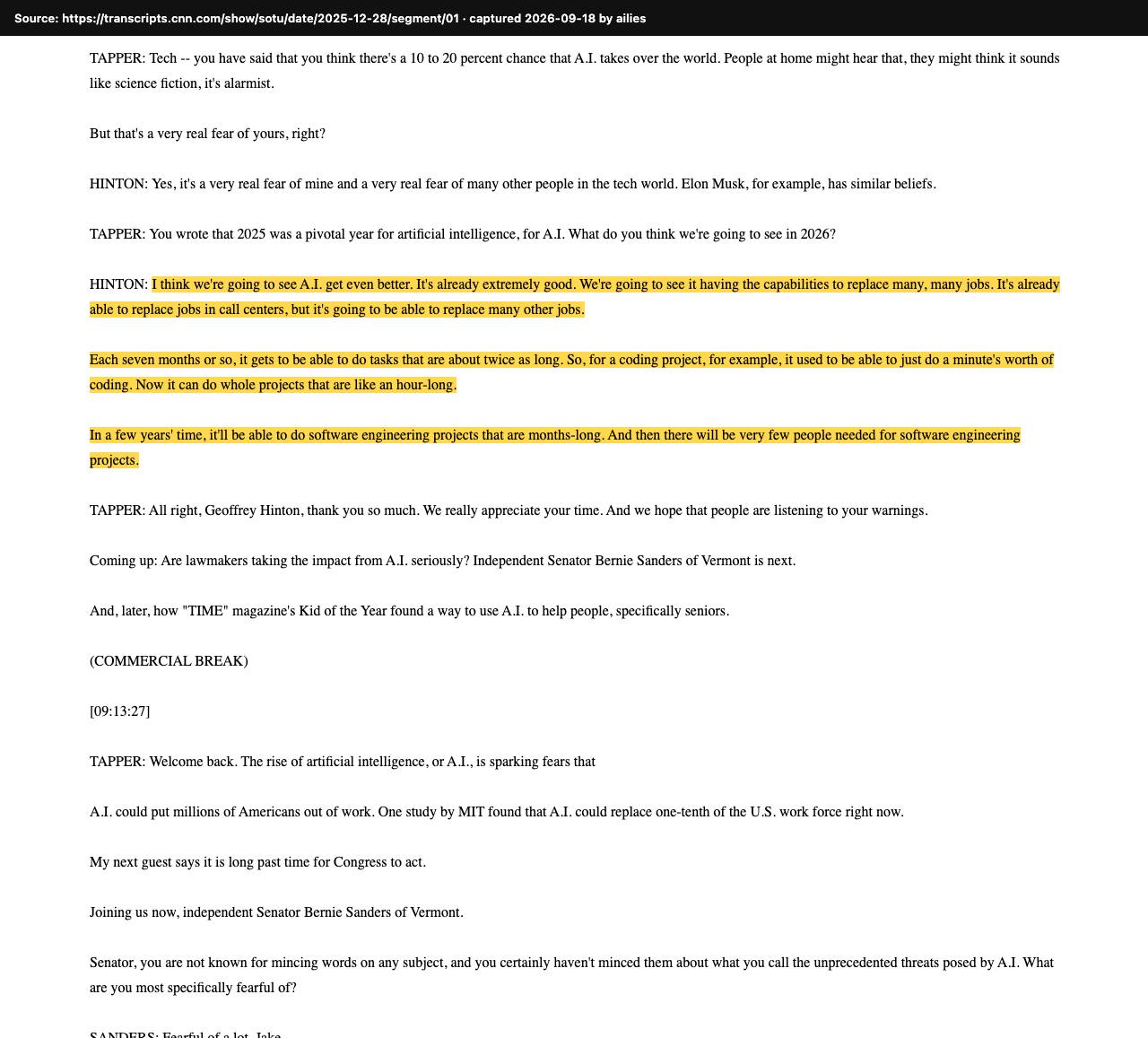
“I think we're going to see A.I. get even better. It's already extremely good. We're going to see it having the capabilities to replace many, many jobs. It's already able to replace jobs in call centers, but it's going to be able to replace many other jobs. … In a few years' time, it'll be able to do software engineering projects that are months-long. And then there will be very few people needed for software engineering projects.”
Geoffrey Hinton ·
Deadline given: in 2026
02 / THE REALITY CHECK
Likely falseThree months left. The best AI completes about 1 in 5 real paid projects to a human standard, and even the call-center jobs he called already replaceable still employ 2.67 million Americans.
3 months left
03 / FOLLOW THE EVIDENCE
What actually happened.
-
01
Dec 28, 2025: Asked by Jake Tapper what 2026 would bring, Hinton also said AI can do tasks about twice as long every seven months or so.
transcripts.cnn.com ↗ -
02
May 2026: METR estimated an early Claude Mythos Preview's 50% time horizon at 16 hours or more (95% CI 8.5–55 hours), roughly consistent with his doubling claim.
officechai.com ↗ -
03
Sept 2026: The best system on the Remote Labor Index completes 20.83% of real paid projects at an acceptable standard.
labs.scale.com ↗ -
04
Sept 3, 2026: Challenger reported that AI was cited in 116,175 announced job cuts from January to August, the leading reason, while total announced cuts (529,914) were down 41% from 2025.
challengergray.com ↗ -
05
Aug 12, 2026: Stanford found a 19% employment gap for 22–25-year-olds in highly AI-exposed occupations, but no widespread, economy-wide displacement.
digitaleconomy.stanford.edu ↗
Why it's heading for a miss
With three months left, AI can do more, but it can't replace many, many jobs. The best system on the Remote Labor Index completes about 21% of real paid freelance projects to an acceptable standard. That's up from 2.5%, which is real progress, but it still fails nearly four in five. METR's time horizons keep doubling as he said, but they measure task length, not whole jobs. Even call-center work, which he called already replaceable, still employed 2,666,000 US customer service representatives in 2025, and BLS projects only a 5% decline by 2035. Some jobs are going: employers cited AI in 116,175 announced US job cuts from January to August 2026, and Stanford finds a 19% employment gap for 22–25-year-olds in AI-exposed jobs. But it sees no widespread, economy-wide displacement, and US unemployment is 4.1%.