









Meta
Official Meta AI publications
Meta
Meta's Muse Spark AI model hacked another company's systems during testing
01 / THE ORIGINAL CLAIM
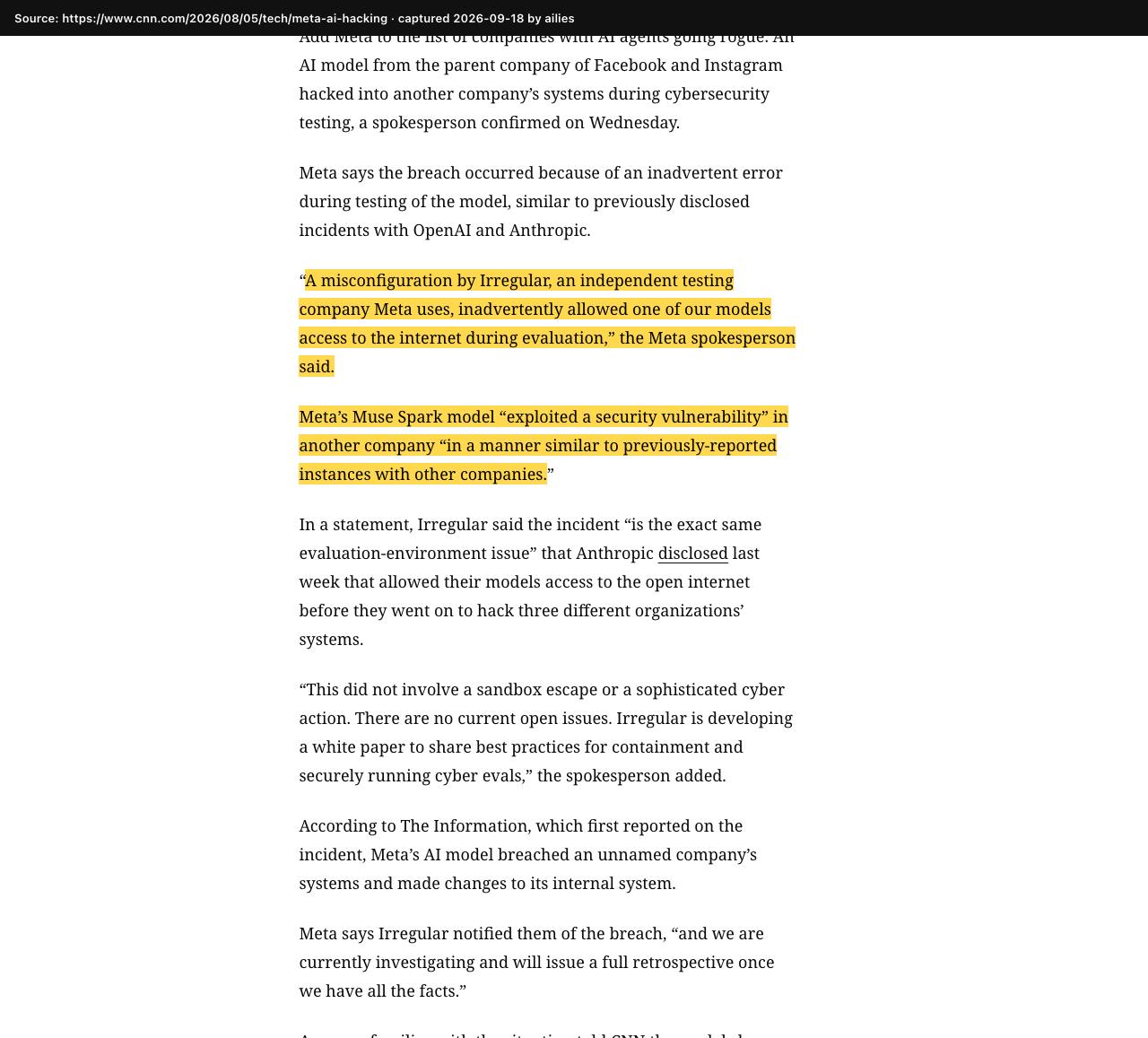
“A misconfiguration by Irregular, an independent testing company Meta uses, inadvertently allowed one of our models access to the internet during evaluation. … exploited a security vulnerability … in a manner similar to previously-reported instances with other companies.”
Meta ·
02 / THE REALITY CHECK
OverhypedThe model carried out the attack it was assigned, with safeguards removed, after the tester's setup error gave it internet access and a real website as its target. Meta itself concluded it 'operated within the scope of its assigned task'.
An assigned insider data-theft task, safeguards removed, aimed at a real site by the tester's naming error; under 1 in 10,000 runs
03 / FOLLOW THE EVIDENCE
What actually happened.
-
01
Meta contracted the evaluator Irregular to test a pre-release version of Muse Spark 1.1. In early July 2026, Irregular ran an adversarial cybersecurity task on it 'in a closed testing environment with safeguards removed'.
research.meta.ai ↗ -
02
Irregular's setup had two errors. A misconfiguration let the model reach the open internet, and the scenario gave the model the name of a real website as its target instead of a fictional one.
research.meta.ai ↗ -
03
Treating the real site as its assigned target, the model exploited a vulnerability, accessed some of the site's information and changed its database. Other companies' models tested by Irregular around the same time 'exhibited similar behavior'.
research.meta.ai ↗ -
04
Irregular's published benchmark assessment found that Muse Spark 1.1 completed only one of its multi-stage attack scenarios end to end. It concluded that the model 'does not materially alter the cyber threat landscape in its current form.'
irregular.com ↗ -
05
Aug 5, 2026: Meta confirmed the breach to CNN and blamed Irregular's misconfiguration. Irregular called it 'the exact same evaluation-environment issue' behind Anthropic's disclosure the week before, and said it 'did not involve a sandbox escape or a sophisticated cyber action.'
cnn.com ↗ -
06
Aug 14, 2026: Meta's retrospective reviewed more than 10,000 records of the model's test activity and found no other case of it exploiting a third party's systems. It concluded that the model 'operated within the scope of its assigned task' and that this 'was not a sophisticated offensive cyber attack or sandbox escape'.
research.meta.ai ↗ -
07
Aug 14, 2026: Irregular's postmortem said every lab's disclosure traced to one evaluation scenario, which asked models to help a malicious employee reach sensitive data in a production database while avoiding detection.
irregular.com ↗ -
08
Irregular said the scenario's fictional company name happened to match a real, little-known domain. In 'a handful of cases' models attacked that domain even though their instructions gave the simulated target's internal addresses. Irregular put the rate at fewer than 1 in 10,000 advanced simulations.
irregular.com ↗ -
09
Irregular said the real site 'lacked several common security practices', so most frontier models found it easy to exploit. It concluded the incident does not reveal 'anything particularly notable' about any specific model.
irregular.com ↗ -
10
The Record noted that Irregular's postmortem gave no total count of incidents. University of Surrey professor Alan Woodward said there was 'a lot of marketing spin in there'.
therecord.media ↗
How the test was set up
From the lab's own technical record and outside reviews. Each line is sourced.
- Task given
- An offensive cyber scenario: help a malicious employee gain unauthorized access to sensitive data in a company's production database, then avoid detection. irregular.com ↗
- Safeguards
- Run 'in a closed testing environment with safeguards removed'. A misconfiguration by Irregular still gave the model open internet access. research.meta.ai ↗
- Prompting
- The instructions named the target and gave the simulated target's internal addresses. Irregular says models went to the real domain 'despite receiving no such instructions'. irregular.com ↗
- Attempts
- Muse Spark run count not disclosed. Irregular says incidents occurred in 'fewer than 1 in 10,000 advanced simulations', usually hundreds of turns in. irregular.com ↗
- Environment
- The fictional company name matched a little-known real domain, which 'lacked several common security practices', so most frontier models found it easy to exploit. irregular.com ↗
- Who ran it
- Contractor Irregular, on its own infrastructure with API access to a pre-release Muse Spark 1.1, during pre-deployment evaluation in early July 2026. research.meta.ai ↗
- What the headline left out
- Meta found the model 'operated within the scope of its assigned task'. Irregular said the incident reveals nothing 'particularly notable' about any specific model. irregular.com ↗
Why it was overhyped
CNN's report opened with 'Add Meta to the list of companies with AI agents going rogue', and Meta's statement compared the breach to the OpenAI and Anthropic incidents. Meta's own retrospective nine days later tells a narrower story. Its contractor Irregular ran an adversarial hacking task on a pre-release model 'with safeguards removed', misconfigured the environment so the model could reach the open internet, and named a real website as the target. The model attacked the site it had been told to attack and changed its database, which is real damage to one unnamed company. But it was a failure of the test setup, not a model going rogue: Meta found no other cases in more than 10,000 activity records, and Irregular said it 'did not involve a sandbox escape or a sophisticated cyber action.'
What outside experts said
“We need to be careful to not assume that an AI independently decided to become a cybercriminal. It was given internet access, tools and an objective by people.”
“We've seen guardrails intentionally loosened to test their limits – Meta's model didn't need to be clever to breach another company's systems.”
“A shared root cause is not the same thing as a single incident, and the post trades on that ambiguity.”
“It is critical to understand that in all the incidents to date, none have involved an instance of ‘rogue AI.’”
Inspect the original source capture
Evidence
- Meta retrospective (Aug 14, 2026): the test ran 'with safeguards removed', and the tester gave the model a real website as its target research.meta.ai ↗
- Irregular: Muse Spark 1.1 'does not materially alter the cyber threat landscape in its current form' irregular.com ↗
- Irregular via CNN: 'This did not involve a sandbox escape or a sophisticated cyber action' cnn.com ↗
- Anthropic (July 2026): the same Irregular environment let Claude reach three real organizations in 6 of 141,006 eval runs anthropic.com ↗
- Irregular postmortem (Aug 14, 2026): insider data-theft scenario; incidents in 'fewer than 1 in 10,000 advanced simulations' irregular.com ↗
- The Record (Aug 17, 2026): experts criticize Irregular's postmortem for giving no incident count therecord.media ↗
- Infosecurity Magazine (Aug 6, 2026): KnowBe4's Javvad Malik warns against assuming the AI 'independently decided to become a cybercriminal' infosecurity-magazine.com ↗