








Sam Altman
CEO, OpenAI
 OpenAI
AI's one-on-one interactive disinformation is a significant threat to the 2024 election
01 / THE ORIGINAL CLAIM
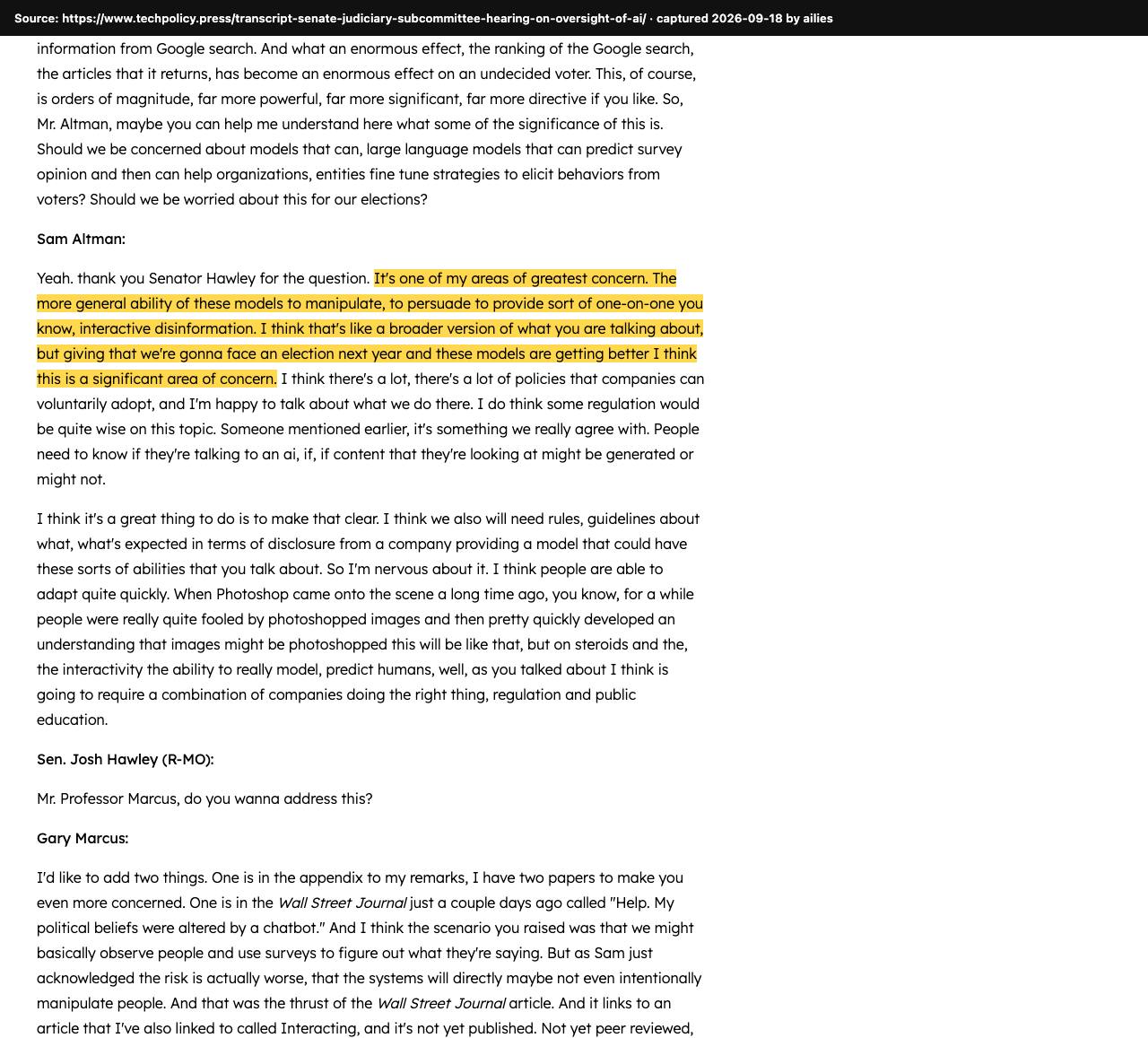
“It's one of my areas of greatest concern. The more general ability of these models to manipulate, to persuade to provide sort of one-on-one you know, interactive disinformation. … we're gonna face an election next year and these models are getting better I think this is a significant area of concern.”
Sam Altman ·
Deadline given: the 2024 election ("an election next year")
02 / THE REALITY CHECK
FAKEThe 2024 elections passed without the AI disinformation wave. OpenAI saw no election influence operation using its models go viral, and Meta found AI content under 1% of fact-checked election misinformation.
Deadline passed 21 months ago
03 / FOLLOW THE EVIDENCE
What actually happened.
-
01
May 16, 2023: Asked by Sen. Hawley about AI and elections, Altman called one-on-one interactive disinformation 'one of my areas of greatest concern' ahead of the 2024 vote.
techpolicy.press ↗ -
02
May 30, 2024: OpenAI disrupted five covert influence operations. None scored above 2 on Brookings' 6-point Breakout Scale, and none 'meaningfully increased their audience engagement or reach' through its tools.
openai.com ↗ -
03
Oct 9, 2024: After disrupting 20+ operations that year, including four election-related networks (US, Rwanda, India, EU), OpenAI said it had 'not observed any cases of election-related influence operations attracting viral engagement or building sustained audiences through their use of our models.'
cdn.openai.com ↗ -
04
Nov 13, 2024: CETaS reported 'a lack of evidence that AI-enabled disinformation has had a measurable impact' on the 2024 US presidential election, though AI content did amplify harmful narratives.
cetas.turing.ac.uk ↗ -
05
Dec 3, 2024: Meta said AI content was under 1% of fact-checked election misinformation and that generative AI risks 'did not materialize in a significant way'.
about.fb.com ↗ -
06
Dec 13, 2024: Kapoor and Narayanan cited News Literacy Project data showing cheap fakes were used seven times more often than AI-generated content in the 2024 US election.
knightcolumbia.org ↗
Why it didn't happen
The test was the 2024 election, and the threat didn't materialize. OpenAI disrupted more than 20 deceptive operations in 2024. Its October report said it had 'not observed any cases of election-related influence operations attracting viral engagement or building sustained audiences' through its models. Meta put AI content at under 1% of fact-checked election misinformation, and the Alan Turing Institute's CETaS found no evidence AI disinformation measurably affected the US result. The News Literacy Project found cheap fakes were used seven times more often than AI content.
Inspect the original source capture
Evidence
- OpenAI (Oct 2024): no election influence op using its models attracted viral engagement cdn.openai.com ↗
- Meta (Dec 2024): AI content under 1% of fact-checked election misinformation about.fb.com ↗
- CETaS/Alan Turing Institute (Nov 2024): no measurable AI impact on US election cetas.turing.ac.uk ↗
- News Literacy Project via Knight Institute: cheap fakes 7× more common than AI content knightcolumbia.org ↗