








Dario Amodei
CEO, Anthropic
 Anthropic
AI could fundamentally change the world within two years
01 / THE ORIGINAL CLAIM
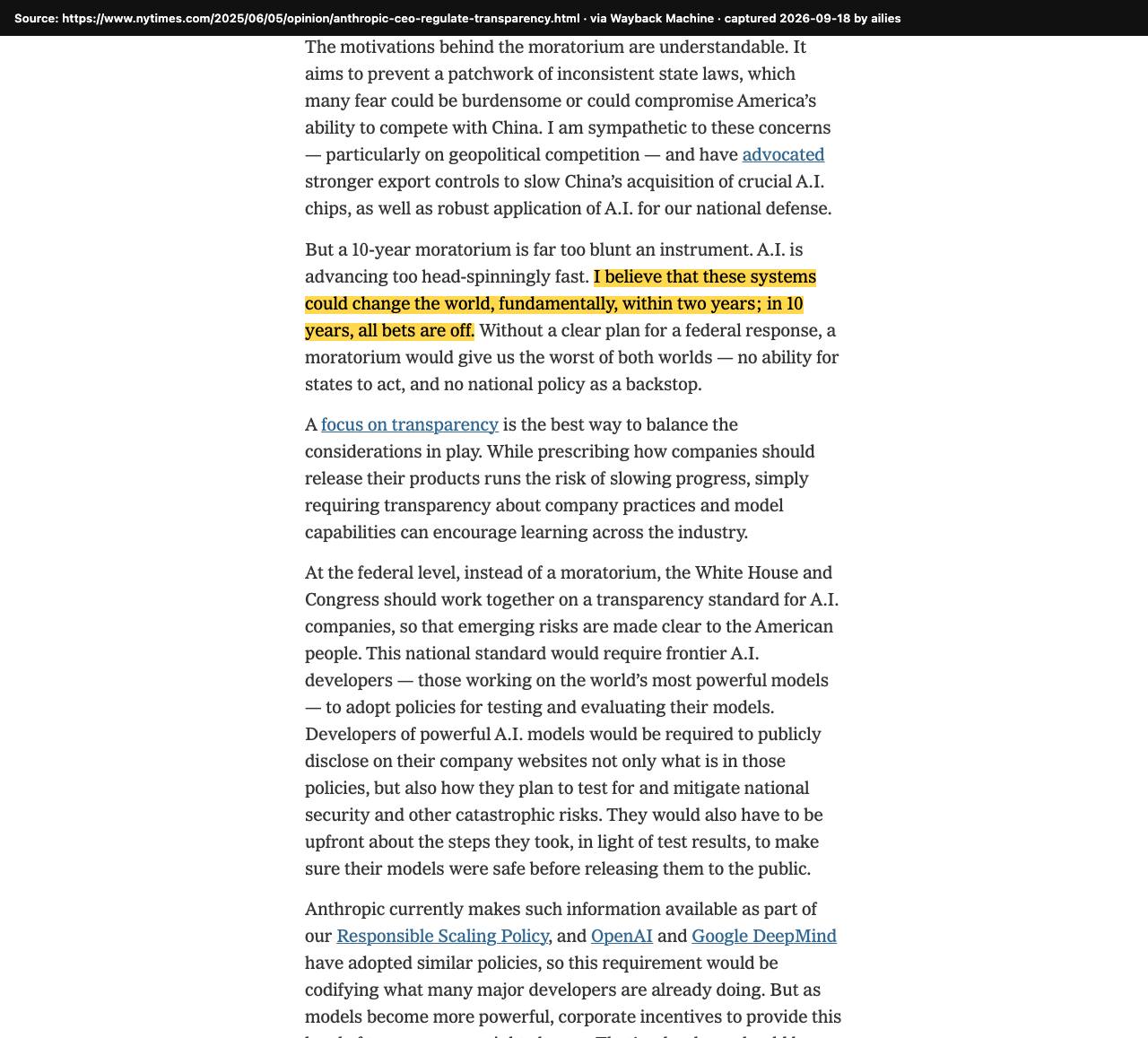
“I believe that these systems could change the world, fundamentally, within two years; in 10 years, all bets are off.”
Dario Amodei ·
Deadline given: within two years
02 / THE REALITY CHECK
Likely falseNine months left. Capabilities leapt, but only 17–20% of US businesses use AI, unemployment is 4.1%, and Yale finds 'no connection' between AI use and jobs.
8 months left
03 / FOLLOW THE EVIDENCE
What actually happened.
-
01
June 5, 2025: Amodei made the forecast in a New York Times guest essay opposing a proposed 10-year federal moratorium on state AI laws, writing that "A.I. is advancing too head-spinningly fast."
nytimes.com ↗ -
02
July 1, 2025: The Senate voted 99–1 to strip the moratorium from the budget bill.
time.com ↗ -
03
May 26, 2026: The Census Bureau reported that overall AI use by US businesses "hovered between 17% and 20%" from December 2025 to May 2026, and 37% among firms with at least 250 employees.
census.gov ↗ -
04
Aug 2, 2026: OpenAI said an internal version of its Astra model solved ten math and theoretical computer science problems open for at least a decade, with fully formalized Lean 4 proofs. None had been peer-reviewed.
siliconangle.com ↗ -
05
Sept 11, 2026: After OpenAI's announcement, the Clay Mathematics Institute said the Navier–Stokes Millennium Problem "has apparently been settled", adding that its evaluation process "is deliberately unhurried".
claymath.org ↗ -
06
Sept 15, 2026: Yale's Budget Lab found that "Measures of AI usage show no connection to changes in employment or unemployment."
budgetlab.yale.edu ↗
Why it's heading for a miss
With nine months left, the world outside the labs hasn't fundamentally changed, and nothing suggests it will by June 2027. 'Change the world, fundamentally' is vague and hedged with 'could', so the test is loose. Capabilities have moved fast: OpenAI says an internal model produced machine-checked proofs for ten math problems open at least a decade, and the Clay Institute says the Navier–Stokes problem has 'apparently been settled'. The broader economy has moved less. The Census Bureau found only 17–20% of US businesses using AI from December 2025 to May 2026, Yale's Budget Lab says AI usage shows 'no connection' to changes in employment or unemployment, and US unemployment was 4.1% in August 2026. Amodei himself says change is accelerating: in September 2026 he wrote that AI has been 'advancing drastically faster' since the summer.
Inspect the original source capture
Evidence
- NYT guest essay: 'could change the world, fundamentally, within two years' nytimes.com ↗
- Census Bureau: 17–20% of US businesses use AI (Dec 2025–May 2026) census.gov ↗
- Yale Budget Lab: AI usage shows no connection to employment changes (updated Sept 15, 2026) budgetlab.yale.edu ↗
- BLS: US unemployment 4.1% (Aug 2026) bls.gov ↗
- Anthropic economist Peter McCrory: 'I don't expect unemployment to be noticeably higher a year from now—at least not because of AI' (July 2026) fortune.com ↗
- Clay Mathematics Institute: Navier–Stokes 'has apparently been settled' (Sept 11, 2026) claymath.org ↗