



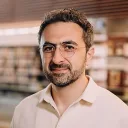


Sam Altman
CEO, OpenAI
 OpenAI
2026 will bring AI that finds novel insights, 2027 robots that do real-world tasks
01 / THE ORIGINAL CLAIM
“2026 will likely see the arrival of systems that can figure out novel insights. 2027 may see the arrival of robots that can do tasks in the real world.”
Sam Altman ·
Deadline given: 2026 for novel insights, 2027 for real-world robots (read as end of 2027)
02 / THE REALITY CHECK
PendingOpenAI's own evidence largely backs the 2026 half with machine-checked proofs of long-open problems, though none is peer-reviewed yet. Robots are still at the pilot stage.
15 months left
03 / FOLLOW THE EVIDENCE
What actually happened.
-
01
June 10, 2025: Altman made the forecast in 'The Gentle Singularity'. The same post noted that "Robots are not yet walking the streets".
blog.samaltman.com ↗ -
02
Oct 18, 2025: OpenAI's Kevin Weil claimed GPT-5 had "found solutions to 10 (!) previously unsolved Erdős problems". The maintainer of the problem list, Thomas Bloom, called this "a dramatic misinterpretation": GPT-5 had found existing papers. Most of the posts were later deleted.
the-decoder.com ↗ -
03
June 25, 2026: BMW said Figure's earlier robots had supported production of more than 30,000 X3s over an 11-month deployment in 2025. It also started a Figure 03 pilot that sorts parts for the assembly line. These are narrow tasks on one line, not general-purpose robots.
press.bmwgroup.com ↗ -
04
Aug 2, 2026: OpenAI said an internal version of Astra solved ten problems open for at least a decade, including an explicit construction of a non-sofic group. The Lean 4 proofs have no gaps ('sorry' count zero). Bloom called it "big news". None of the results had been peer-reviewed.
siliconangle.com ↗ -
05
Sept 8, 2026: OpenAI said a multi-agent system that at one point ran 10,000 sub-agents had solved Navier–Stokes. Mathematician Tristan Buckmaster accused OpenAI of using his and Levent Alpöge's approach, which OpenAI denied.
fortune.com ↗ -
06
Sept 11, 2026: The Clay Mathematics Institute said the problem "has apparently been settled", adding that its evaluation process "is deliberately unhurried".
claymath.org ↗
Where things stand
The two halves have fared differently. For 'novel insights', OpenAI published Lean-verified proofs for ten problems open at least a decade (August 2026) and a Lean-certified Navier–Stokes blowup proof (September 2026), after which the Clay Institute said the problem 'has apparently been settled'. The caveats: none of these results has passed peer review, OpenAI overclaimed on Erdős problems in October 2025, and mathematician Tristan Buckmaster alleges OpenAI took up his and Levent Alpöge's approach after learning of it, which OpenAI denies. On robots, humanoids are doing narrow factory pilots, such as Figure's robots at BMW. Elon Musk, by contrast, admitted in January 2026 that no Optimus robots were doing 'useful work', and 2027 hasn't arrived yet.
Inspect the original source capture
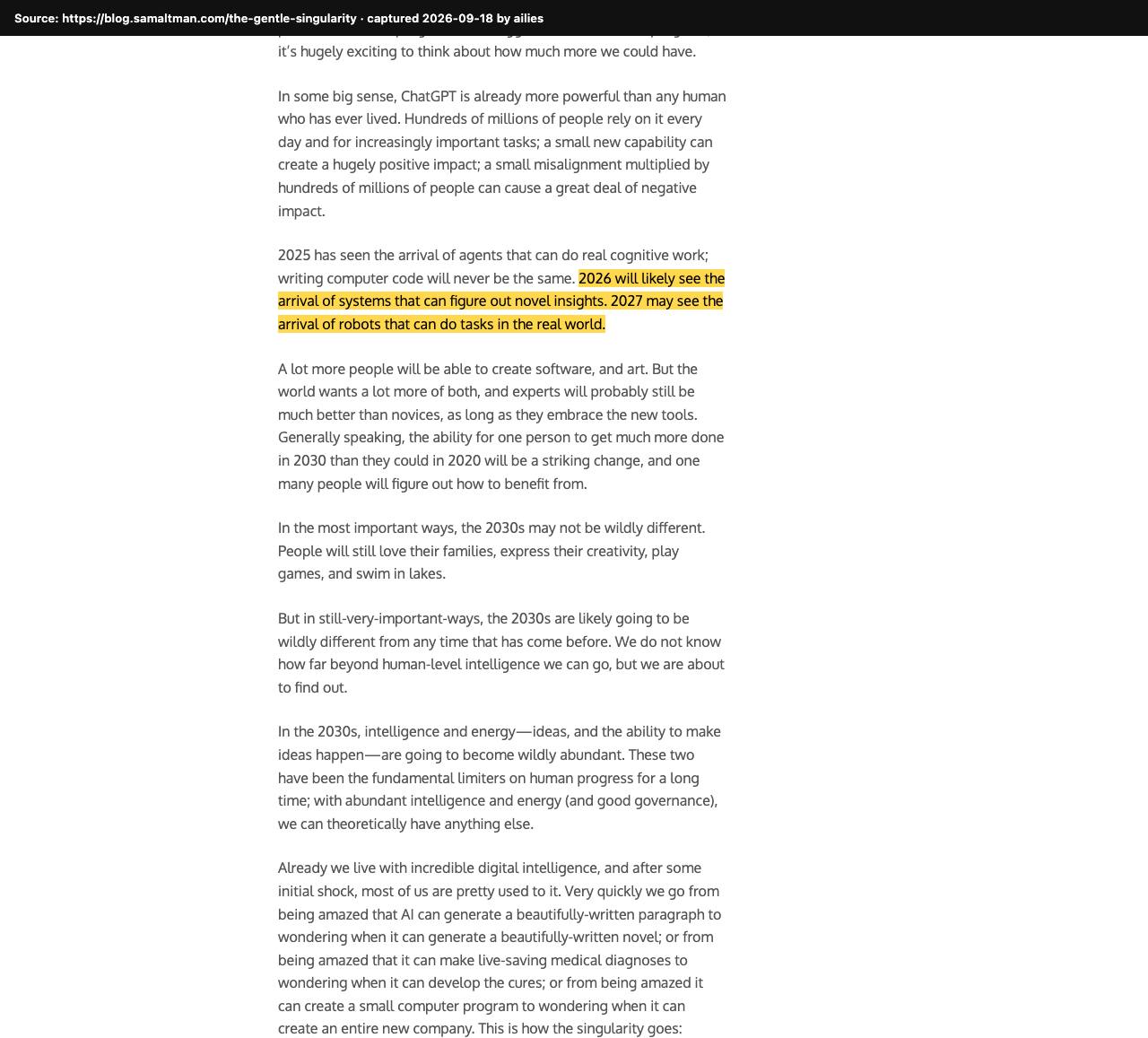
Evidence
- SiliconANGLE: Astra's ten results, fully formalized in Lean, not yet peer-reviewed (Aug 2026) siliconangle.com ↗
- Scientific American: Navier–Stokes proof 'certified using the programming language Lean'; OpenAI's proof followed a method similar to Buckmaster and Alpöge's (Sept 2026) scientificamerican.com ↗
- Clay Institute: Navier–Stokes 'has apparently been settled' (Sept 11, 2026) claymath.org ↗
- The Decoder: Weil's Erdős claim was 'a dramatic misinterpretation' (Oct 2025) the-decoder.com ↗
- BMW: Figure robots supported 30,000+ X3s; Figure 03 pilot is a new use case (June 2026) press.bmwgroup.com ↗
- Electrek: Musk admitted zero Optimus robots doing 'useful work' (Jan 2026) electrek.co ↗