










Google Threat Intelligence Group
Google's threat-intelligence unit (GTIG, incl. Mandiant)
Google
Hackers now deploy AI malware that alters its behavior mid-attack, a 'new phase' of AI abuse
01 / THE ORIGINAL CLAIM
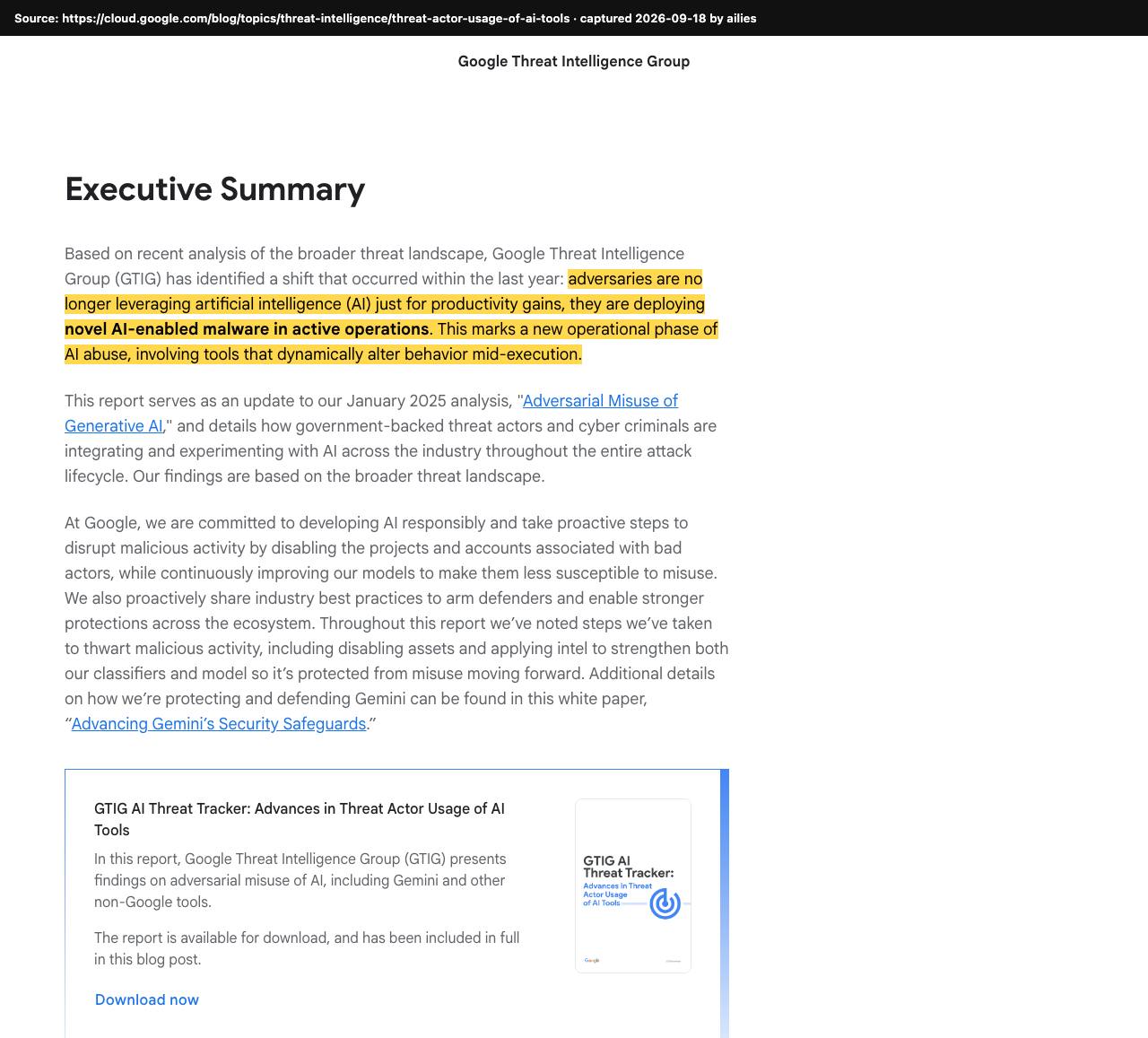
“adversaries are no longer leveraging artificial intelligence (AI) just for productivity gains, they are deploying novel AI-enabled malware in active operations. This marks a new operational phase of AI abuse, involving tools that dynamically alter behavior mid-execution.”
Google Threat Intelligence Group ·
02 / THE REALITY CHECK
OverhypedReal malware that called LLMs, but it was crude, easy to detect and had no operational impact. The self-rewriting flagship sample was an experiment with no demonstrated ability to compromise a device.
PROMPTFLUX: 'Experimental', with no demonstrated ability to compromise a device
03 / FOLLOW THE EVIDENCE
What actually happened.
-
01
GTIG's November 2025 AI Threat Tracker said adversaries were 'deploying novel AI-enabled malware in active operations', calling it 'a new operational phase of AI abuse'.
cloud.google.com ↗ -
02
The headline example, PROMPTFLUX, asks Gemini to rewrite its own VBScript to evade antivirus. Google labeled it 'Experimental', found commented-out features and an API-call limiter, and said it 'does not demonstrate an ability to compromise a victim network or device'.
cloud.google.com ↗ -
03
Of the five families, three (FRUITSHELL, PROMPTSTEAL, QUIETVAULT) were 'Observed in operations'. APT28 used PROMPTSTEAL, which asks an open Qwen model for shell commands, against Ukraine.
cloud.google.com ↗ -
04
Ars Technica found all five samples easy to detect, even by static-signature tools, reusing known methods and with no operational impact. Kevin Beaumont: 'this does not show a credible threat or movement towards a credible threat.'
arstechnica.com ↗ -
05
Headlines echoed Google's framing, e.g. Infosecurity Magazine: 'AI-Enabled Malware Now Actively Deployed, Says Google'.
infosecurity-magazine.com ↗ -
06
By September 2026, GTIG reported attackers moving to agentic workflows. In Q2 2026 one group built and ran an agent-enabled mass credential-harvesting campaign in under six hours.
cloud.google.com ↗ -
07
PROMPTFLUX's 'Thinking Robot' module sent a hard-coded Gemini API key and a fixed prompt to 'gemini-1.5-flash-latest' and logged replies to a temp file. Google says it disabled the assets tied to the activity.
cloud.google.com ↗ -
08
PROMPTLOCK, one of Google's two 'Experimental' samples, turned out to be an NYU Tandon research prototype that ESET had first announced as the first AI-powered ransomware.
engineering.nyu.edu ↗ -
09
Malware researcher Marcus Hutchins said the prompt assumed 'Gemini just instinctively knows how to evade antiviruses (it doesn't)', and that the self-modifying function 'was also commented out and not even in use.'
thehackernews.com ↗ -
10
Dec 2025: GTIG's Billy Leonard told CSO Online that productivity uses are still 'the biggest slice of the pie' in how attackers use generative AI.
csoonline.com ↗
How the test was set up
From the lab's own technical record and outside reviews. Each line is sourced.
- Task given
- Not a model test. Unknown malware authors hard-coded a prompt asking Gemini ('gemini-1.5-flash-latest') for VBScript antivirus-evasion code. cloud.google.com ↗
- Safeguards
- PROMPTFLUX called Google's Gemini API with a hard-coded API key. Google says it disabled the associated assets and strengthened its classifiers and the model. cloud.google.com ↗
- Prompting
- One variant tells Gemini to act as an 'expert VBScript obfuscator' and rewrite the malware's entire source code hourly, outputting only code. cloud.google.com ↗
- Attempts
- Sample and API-call counts not disclosed. GTIG found a limiter on Gemini calls and the self-update function (AttemptToUpdateSelf) commented out. cloud.google.com ↗
- Environment
- GTIG says PROMPTFLUX was 'in a development or testing phase, as opposed to being used in the wild', and could not compromise a device. cloud.google.com ↗
- Who ran it
- PROMPTFLUX is unattributed, likely financially motivated. APT28's in-the-wild PROMPTSTEAL queried Qwen via Hugging Face, not Gemini. PROMPTLOCK was an NYU research prototype. cloud.google.com ↗
- What the headline left out
- None of the three families seen in operations rewrites itself. GTIG describes FRUITSHELL only as carrying prompts meant to fool LLM-based security tools. cloud.google.com ↗
Why it was overhyped
Google's framing, a 'new operational phase of AI abuse', went further than its own findings. The headline example, PROMPTFLUX, was labeled 'Experimental', and Google said it 'does not demonstrate an ability to compromise a victim network or device'. Three of the five families were seen in real operations, including APT28's PROMPTSTEAL against Ukraine, but Ars Technica found all five easy to catch with static signatures and without operational impact. These were human attackers calling an LLM, not AI attacking on its own. By 2026 GTIG was reporting faster, agent-driven campaigns, so the trend is worth watching.
What outside experts said
“If you were paying malware developers for this, you would be furiously asking for a refund as this does not show a credible threat or movement towards a credible threat.”
“working under the assumption that Gemini just instinctively knows how to evade antiviruses (it doesn't)”
“Still, these disclaimers are rarely made prominently and are often downplayed in the resulting frenzy to portray AI-assisted malware as posing a near-term threat.”
Inspect the original source capture
Evidence
- GTIG table: PROMPTFLUX and PROMPTLOCK 'Experimental'; three families 'Observed in operations' cloud.google.com ↗
- Ars Technica: '5 AI-developed malware families analyzed by Google fail to work and are easily detected' (Nov 5, 2025) arstechnica.com ↗
- GTIG (Sept 2026): shift to agentic AI workflows in Q2 2026 cloud.google.com ↗
- Hutchins on PROMPTFLUX (via The Hacker News): 'The function was also commented out and not even in use' thehackernews.com ↗
- NYU Tandon: PromptLock 'was not actual malware but a research prototype from NYU Tandon' engineering.nyu.edu ↗
- CSO Online (Dec 9, 2025): GTIG's Billy Leonard says productivity uses remain 'the biggest slice of the pie' csoonline.com ↗