










Daniel Kokotajlo
Former OpenAI governance researcher; Executive Director, AI Futures Project
AI 2027: superhuman coder by March 2027, AI beats all humans at all tasks by end of 2027
01 / THE ORIGINAL CLAIM
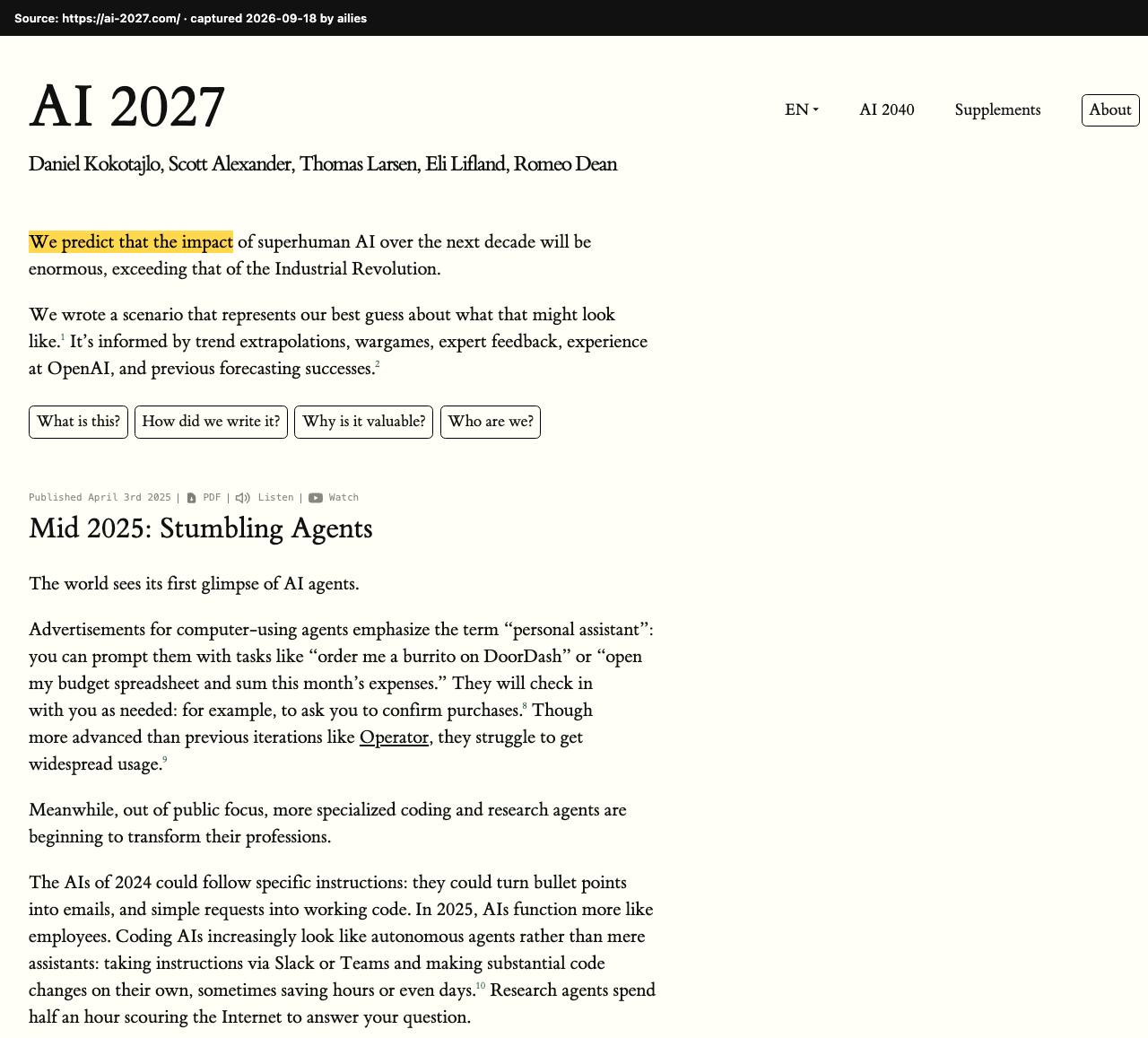
“We predict that the impact of superhuman AI over the next decade will be enormous, exceeding that of the Industrial Revolution. … Over the course of 2027, the AIs improve from being able to mostly do the job of an OpenBrain research engineer to eclipsing all humans at all tasks.”
Daniel Kokotajlo ·
Deadline given: 2027 (the scenario's most likely year; authors' medians 2028–2032)
02 / THE REALITY CHECK
Likely falseThe authors' own grading has reality at 70–90% of the scenario's pace, and Kokotajlo's median for an automated coder is now mid-2028, after this deadline.
15 months left
03 / FOLLOW THE EVIDENCE
What actually happened.
-
01
AI 2027 was published on 3 April 2025. It forecast a superhuman coder in March 2027, and a footnote said the scenario 'depicts something like our mode', with medians 'somewhat longer'.
ai-2027.com ↗ -
02
In July 2025 the authors pushed their median back 1.5 years. In November 2025 they added: '2027 was our modal (most likely) year… our medians were somewhat longer', with medians ranging from 2028 to 2032.
ai-2027.com ↗ -
03
On 2 April 2026 Kokotajlo moved his automated-coder median forward from late 2029 to mid-2028. He cited new METR time-horizon data and lab insiders 'doubling down' on short timelines.
lesswrong.com ↗ -
04
In the 16 August 2026 update, the authors graded reality at 'roughly 70-90% the speed of AI 2027'. They estimated that at 75% pace an automated coder would arrive in mid-2027, and called the mid-2026 China section 'more of a miss'.
blog.aifutures.org ↗ -
05
For scale: METR's best-measured model (Claude Mythos Preview, April 2026) has a 50% horizon of about 17 hours but an 80% horizon of about 3 hours. The scenario projected that, if the trend kept speeding up, AIs could reach 80% reliability by March 2027 on tasks that take a skilled human years.
metr.org ↗ -
06
OpenAI said in September 2026 that it had built an 'automated research intern' that handles well-defined tasks 'under human direction'. Its target for a true automated AI researcher is March 2028, after the scenario's dates.
engadget.com ↗
Why it's heading for a miss
The scenario's own authors now expect its milestones later than 2027. AI 2027 was written as a scenario. Its 2027 dates were the authors' 'mode' (most likely year); their medians ranged from 2028 to 2032, which they made explicit in a November 2025 clarification. Kokotajlo's own median for an automated coder was late 2029 in the December 2025 AI Futures Model, and he moved it to mid-2028 in April 2026. In August 2026 the team said reality was running at about '70-90%' of the scenario's speed, and that the mid-2026 'China wakes up' section had missed.
Inspect the original source capture
Evidence
- AI 2027 site with footnotes and later clarifications ai-2027.com ↗
- Q1 2026 update: Kokotajlo's AC median late 2029 → mid-2028 lesswrong.com ↗
- Q2.5 2026 update: reality at ~70–90% of AI 2027 pace blog.aifutures.org ↗
- METR time horizons (Mythos ~17 h at 50%, ~3 h at 80%) metr.org ↗
- Altman: automated AI researcher target March 2028 x.com ↗