









OpenAI
Official OpenAI publications (system cards, blog posts)
OpenAI
GPT-2 is too risky to release because it could mass-produce fake news, spam and impersonation
01 / THE ORIGINAL CLAIM
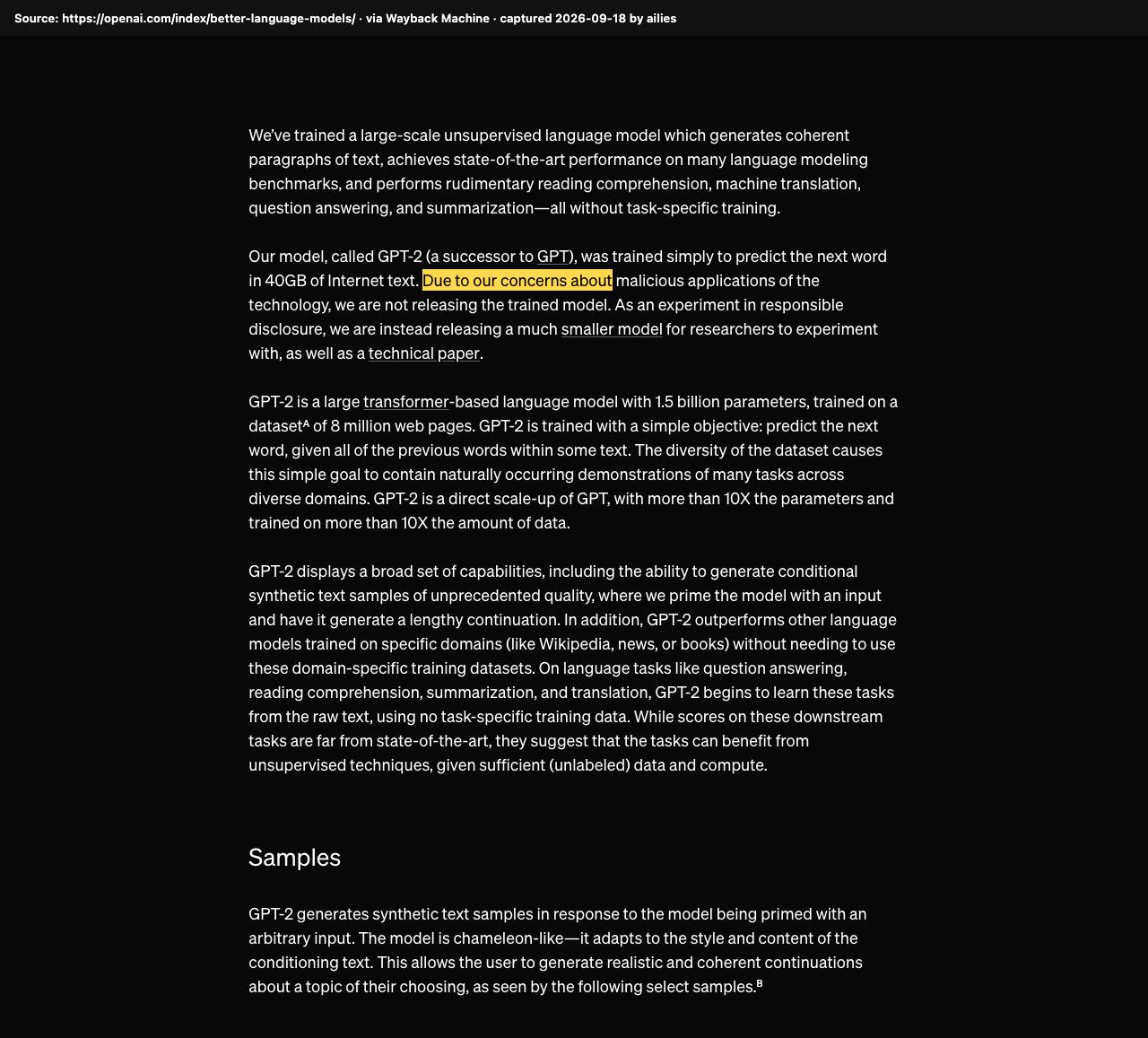
“Due to our concerns about malicious applications of the technology, we are not releasing the trained model. … These findings, combined with earlier results on synthetic imagery, audio, and video, imply that technologies are reducing the cost of generating fake content and waging disinformation campaigns.”
OpenAI ·
Deadline given: until OpenAI released the full model itself (Nov 2019)
02 / THE REALITY CHECK
FAKEOpenAI released the full model itself nine months later and found 'no strong evidence of misuse'. In 2025 it called its own caution 'outsized'.
Deadline passed 6.9 years ago
03 / FOLLOW THE EVIDENCE
What actually happened.
-
01
Feb 14, 2019: OpenAI released only a much smaller GPT-2 and withheld the 1.5B-parameter model, its weights, dataset and training code. It listed misuses such as misleading news articles, online impersonation and automated spam.
openai.com ↗ -
02
May–Aug 2019: OpenAI released the 355M and then the 774M model in stages. By August it said it had spoken with 'more than five groups who have replicated GPT‑2.'
openai.com ↗ -
03
Aug 2019: Two recent master's graduates, Aaron Gokaslan and Vanya Cohen, released their own recreation of the withheld model, trained with about $50,000 of Google cloud compute.
artificialintelligence-news.com ↗ -
04
Nov 5, 2019: OpenAI released the full 1.5B model and wrote: 'We've seen no strong evidence of misuse so far.' Its Cornell partners found people rated 1.5B text only marginally more credible than 774M text (6.91 vs 6.72 out of 10).
openai.com ↗ -
05
Mar 2022: After two years of running its API, OpenAI said misuse 'often comes in different forms than we feared most'. It named spam for dubious medical products and racist role-play, not the influence operations it had focused on.
openai.com ↗ -
06
Mar 2025: OpenAI wrote that GPT-2's withholding reflected 'treating the systems of today with outsized caution relative to their apparent power', an approach it has since replaced with iterative deployment.
openai.com ↗
Why it didn't happen
OpenAI settled this itself by releasing the model it had called too dangerous. OpenAI withheld the 1.5B-parameter GPT-2 over fears of fake news, impersonation and spam. By August 2019 more than five groups had replicated it, and two graduate students released a full-size copy built with about $50,000 of cloud compute. When OpenAI released the full model in November 2019 it reported 'no strong evidence of misuse'. In 2025 it described the original decision as 'outsized caution relative to their apparent power'.
Inspect the original source capture
Evidence
- OpenAI (Nov 2019): 'no strong evidence of misuse' of GPT-2 openai.com ↗
- OpenAI (Aug 2019): 'more than five groups' had already replicated GPT-2 openai.com ↗
- Grad students recreated the withheld model for ~$50,000 of compute (Aug 2019) artificialintelligence-news.com ↗
- OpenAI (Mar 2025): GPT-2 decision was 'outsized caution relative to their apparent power' openai.com ↗