









OpenAI
Official OpenAI publications (system cards, blog posts)
OpenAI
Voice Engine's 15-second voice cloning is too risky to release widely in an election year
01 / THE ORIGINAL CLAIM
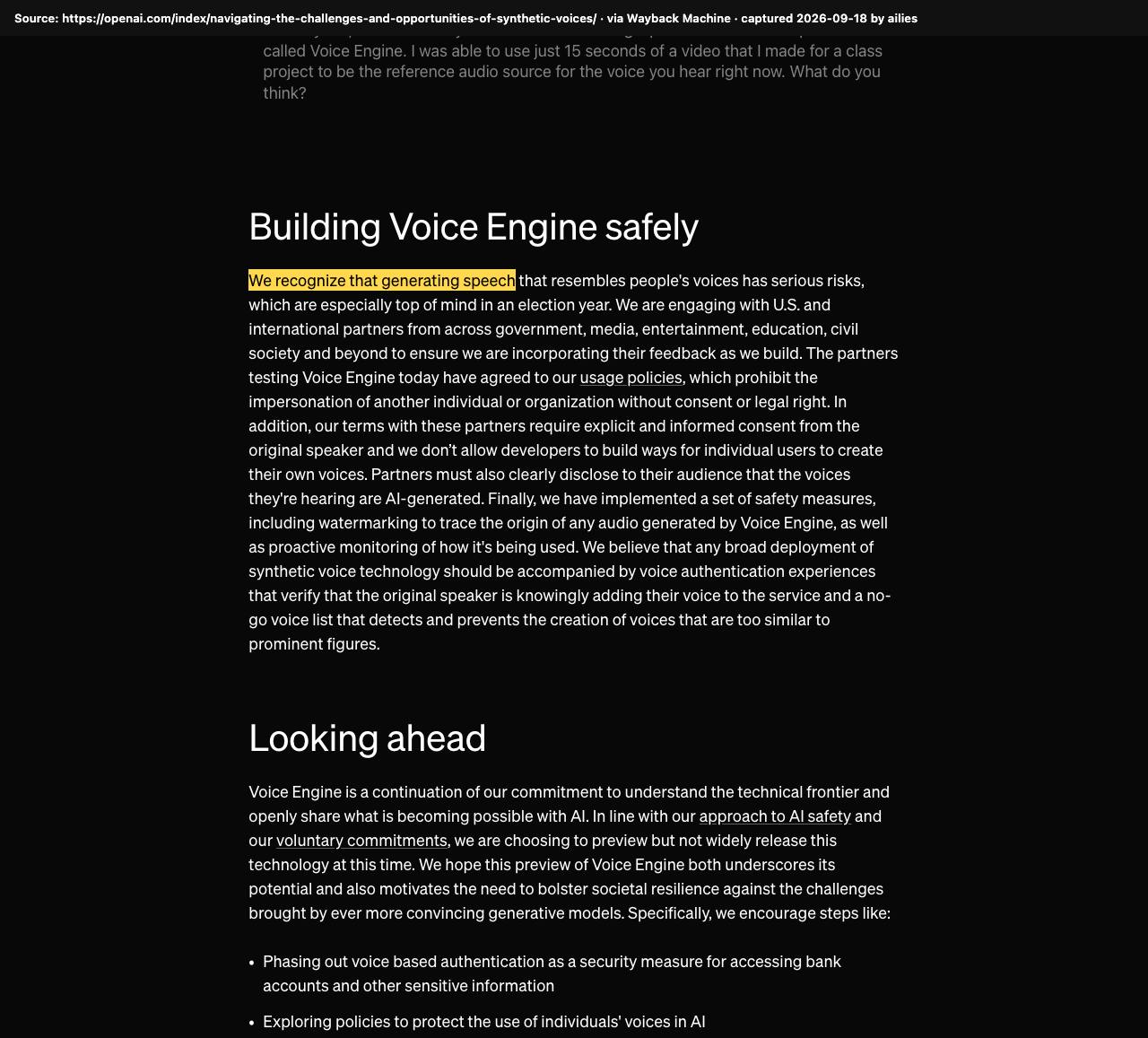
“We recognize that generating speech that resembles people's voices has serious risks, which are especially top of mind in an election year. … we are choosing to preview but not widely release this technology at this time.”
OpenAI ·
Deadline given: the 2024 election year it cited
02 / THE REALITY CHECK
FAKEThe 2024 election year passed without the voice-clone disruption OpenAI cited, and rival cloning tools with weaker checks were on sale the whole time.
Deadline passed 21 months ago
03 / FOLLOW THE EVIDENCE
What actually happened.
-
01
Mar 29, 2024: OpenAI previewed Voice Engine, which clones a voice from a single 15-second sample, but limited it to a few trusted partners, citing election-year impersonation risks.
openai.com ↗ -
02
OpenAI had planned to open Voice Engine to about 100 'trusted developers' on March 7, 2024, then pulled back. A year later it was still in limited preview with no launch date.
techcrunch.com ↗ -
03
Other companies shipped voice cloning anyway. A March 2025 Consumer Reports review found four of six popular products (ElevenLabs, Speechify, PlayHT, Lovo) had no technical check that the speaker had consented.
innovation.consumerreports.org ↗ -
04
Apr 2024: Microsoft's Threat Analysis Center said deepfakes had 'so far not caused mass deception', while noting AI audio worked better on audiences than AI video.
blogs.microsoft.com ↗ -
05
Dec 2024: Meta said AI content made up less than 1% of all fact-checked misinformation during that year's major elections.
about.fb.com ↗ -
06
May 2025: The harm showed up elsewhere. The FBI warned that attackers were sending AI-generated voice messages posing as senior US officials, using tools other than Voice Engine.
ic3.gov ↗
Why it didn't happen
The risk window OpenAI named, the 2024 election year, closed without the harm it feared. OpenAI withheld Voice Engine citing election-year risks, but the feared disruption never came. Microsoft found deepfakes had 'so far not caused mass deception', and Meta put AI content at under 1% of fact-checked election misinformation. Withholding changed little anyway, because voice cloning was already on sale: Consumer Reports found four of six popular tools had no technical consent check. Impersonation scams did grow (the FBI warned in May 2025 of AI voice messages posing as US officials), but through other tools, and it wasn't the election threat OpenAI cited.
Inspect the original source capture
Evidence
- Consumer Reports (Mar 2025): 4 of 6 voice-cloning products lacked real consent checks innovation.consumerreports.org ↗
- Meta (Dec 2024): AI content under 1% of fact-checked election misinformation about.fb.com ↗
- FBI (May 2025): AI voice messages used to impersonate senior US officials ic3.gov ↗
- OpenAI 'custom voices' today: limited to eligible customers, consent recording required developers.openai.com ↗